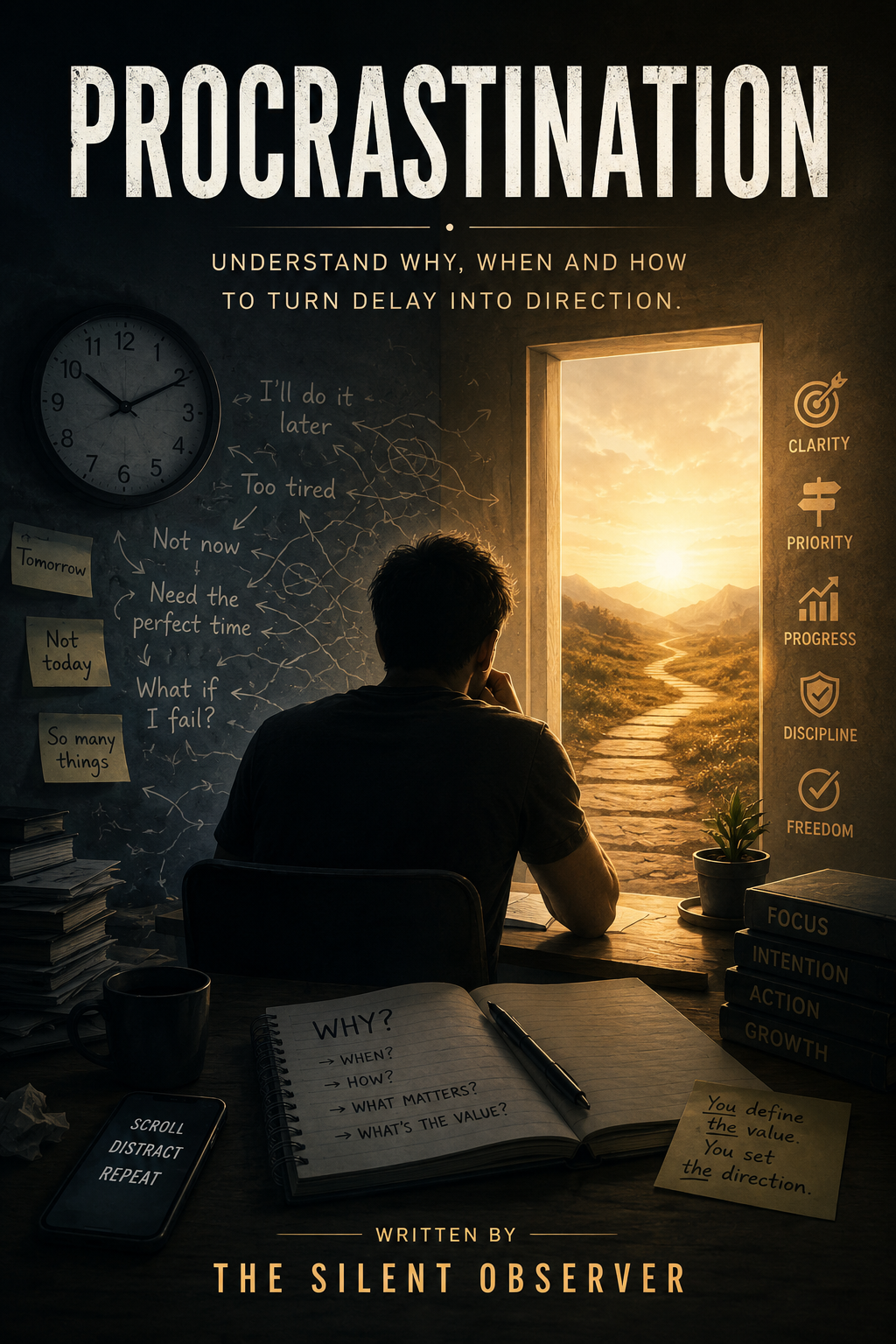
Would you believe me if I said procrastination can be healthy; but only if you understand why, when, and how you procrastinate?
Before we dive into the article, let us ask an honest question to ourselves, what is procrastination and what does it mean to us.
“The act of putting off something to do till a day or time, because you don’t want to do it.”
I agree with the first part, but disagree with the latter part, “Don’t want to do” seems to be more of a judgement or assumption.
Remember the alarm ringing in the morning? We snooze it for 10 more minutes. Does that mean that we are hesitant to get up? Or are we lazy?
In most cases procrastination often stems from the fact that you haven’t fixed a value, for example if you were to catch a train in the early morning, you tend to respond.
Before you go to the technicalities on why we operate better with a value, let’s explore another example.
Let’s talk about one trying to improve his health, going to the gym, drafting a diet plan and workout regime. Some stop before taking the first step, some stop after the draft, many drop from midway and wait for the optimum time to restart.
You find the difference between alarm examples and fitness regime. While both are a byproduct of misalignment of values. The alarm is straightforward, more dependent on one variable, the fitness regime, however is complex.
For simple tasks adding priority or urgency will help to achieve the value. For a task like a fitness regime, solving it by playing pick the stick ain’t going to work.
Humans are naturally born to do things on the fly. We are programmed to do things without thinking, when we were hungry, we hunted. When we were sleepy we slept. When we wanted to walk, we walked miles without knowing the destination.
How did these habits change?
We were not only gifted with a processor called “Brain”, we were also gifted with something called the “Memory”. Memory storage is not simple in humans, it has tagged with metadata.
Memory is the core reason we procrastinate. Imagine a cave man hunting for food, encounters a lion. He gets bruised and barely escapes. The incident records in the memory and shapes his behavior. Let’s park the Alpha mentality of humans for another day. Yes, humans were programmed to be alphas but the understanding of the word alpha has changed with each generation.
“I came, I saw, I conquered.” Not just the words of Julius Caesar but the way the human race behaved. The shift in how we process information altered our mental landscape, as singular memories and personal perceptions fused into a shared societal structure.
Memories became perceptions, perceptions invented social structure and social acceptance. The stories of our grandparents and parents inadvertently became our guardrails.
Let us say today I put up the same quote “I came, I saw, I conquered.” Many will immediately connect it with Caesar, some might question the tone, others might question what I conquered or achieved.
If I am able to perform 3 sets of push ups with 10 reps each and the people around me can do higher sets with higher reps. Does that mean it isn’t an achievement?
Social norms, means, medians, averages are baked onto us indirectly by the daily feeds of our eyes, our ears and all our sensory organs.
I would be wrong to say that procrastination stems only from the outside world and not from within ourselves. Whether we fall into the perfectionist trap, become the chronic overthinker, or remain a vivid dreamer, we frequently construct or dissolve our own boundaries. Often, we neglect to transcend these self-imposed limits, becoming ensnared in a cycle much like a programmer who neglects to implement a necessary break statement.
Our tasks should mimic the lines of code we write. The program should complete or hit an exit criteria. Exit criteria are not the same as error handling. When the task is complex, breaking it down with exit criteria helps us be progressive.
Procrastination can be good and healthy only when you know why, when and how you procrastinate. This applies strongly to the individual and shouldn’t be compared. You define the weights, you define the priority and you define the value based on the progressive guardrails.
Remember, the memories, perceptions and processing varies from person to person. Let’s see how we can reverse program our brain.
Writing the tasks and the reason is the first step of reverse programming your brain. When the human brain sees the blocks, we naturally try to overcome them. Next is the most critical step and often the hardest. You will have to identify if the reason is external or internal. You can try a close ended loop of questions, that drills further down to find the reason.
For example, if one is a perfectionist and needs time to be perfect and often ends up hitting the snooze button. You can start with Why am I a perfectionist? When did I start becoming a perfectionist? Why should I be perfect? How does being a perfectionist affect or improve my life?
Remember there is nothing wrong in being a perfectionist. You will have to evaluate how being a perfectionist affects your life or ability to perform a task.
Once you understand the reason, next we will have to assign weights like impact, urgency, outcome. Here impact goes both ways, first, the impact of not doing the task and second the impact it would create on performing the task.
Once we have found the weights, we need to derive the value for completing the task. Refrain from using dopamine values. Then it sets a dopamine cycle for each task.
Finally we eliminate waste. Social norms are important for any stage of a civilization. Be careful in considering waste. Social norms are guardrails, not the end goal or defining factor.
Ultimately, procrastination isn’t a character flaw to be eradicated, but a signal to be decoded. By acknowledging your personal history, your memories and perceptions that shape your reactions, you shift from being a victim of your habits to an architect of your output.
When you consciously apply this framework, you move beyond the label of ‘procrastinator’ and start treating your delays as data points. Viewed this way, procrastination is no longer a barrier. It becomes a tool for better self-awareness, allowing you to re-engineer your responses and regain control over your time. Healthy procrastination isn’t about avoiding work, it’s about understanding why you avoid it, so you can choose to engage with purpose.