
Is Automation still relevant today?
Automation is something that is going to be relevant any day. Looking to the past or the future, automation was and will be the key driver in human evolution. Its roots go back to the ancient civilizations, the shadoof used for irrigation, the discovery of wheels. These may seem mechanical but the drive of simplification of daily life is what powered them. Automation is the concept of performing tasks with little to no human intervention, which simplifies life and saves time.
Lets take a step back, Automation is there in the human body, do you recall Reflex actions? The beating of the heart, flow of blood, our breathing. Our body has more automation than we think. 206 bones and more than 200 joints give us the autonomy to walk, run and do work.
Automation is everywhere imaginable. You walk through the door of your house thinking about the automation in your body, the lights turn on as you step in and the coffee machine is brewing with the laundry done, dishes washed. These automation can make your life simple, but do you need the same action every time you come through the door? Probably not, but you can enhance it by defining a timebased action flow. If you think about IoT, the possibilities are unlimited. In a world moving fast around us, these small wins help us claw our lives back by gaining a few minutes to several hours.
In the enterprise world and in our work life, the emphasis has always been on Automation, it once feared that it would replace humans. However It has slowly evolved to be a metric of efficiency and sneaked in as a key KPI in the industry. The displacement effect of automation is true, I wouldn’t blame the automation but the absence of a framework and trust me this is a topic for another thread.
Today Automation is relevant, in fact more relevant in the agentic age. Displacement fear might be one of the byproducts, but there is a far more important outcome, Empowerment! How we harness empowerment, depends again on a framework.
Automation empowers humans. Hold on to the thought, register it and start exploring how it empowers.
Automation hovers around improving monitoring, automating service requests and identifying opportunities of automating repeatable tasks.
The continuous service improvement cycle framework, the problem management framework, and the waste elimination framework helps identify the opportunities for automation. Observe, I am calling these as frameworks, you would need to build a framework for enabling these concepts and reaping the benefits.
Without frameworks using the terms and techniques alone won’t produce results or address the answer to empowerment.
Automation is a process and a never ending one. The state of a civilization is temporary.
Why Stop At Automation?
Assume, we have set up a bunch of automation and rules, does it stop there?
The answer obviously is “No”!.Not all automation requires human intervention, but an automated state is temporary. We often build upon the existing automations, discarding a few based on lifecycle management.
Let’s pause for a minute, and ask ourselves, do we maintain an index of automations and have a lifecycle management process?
Like the gears of a machine, these are crucial cogs and need documentation and lifecycle management.
Self-Healing
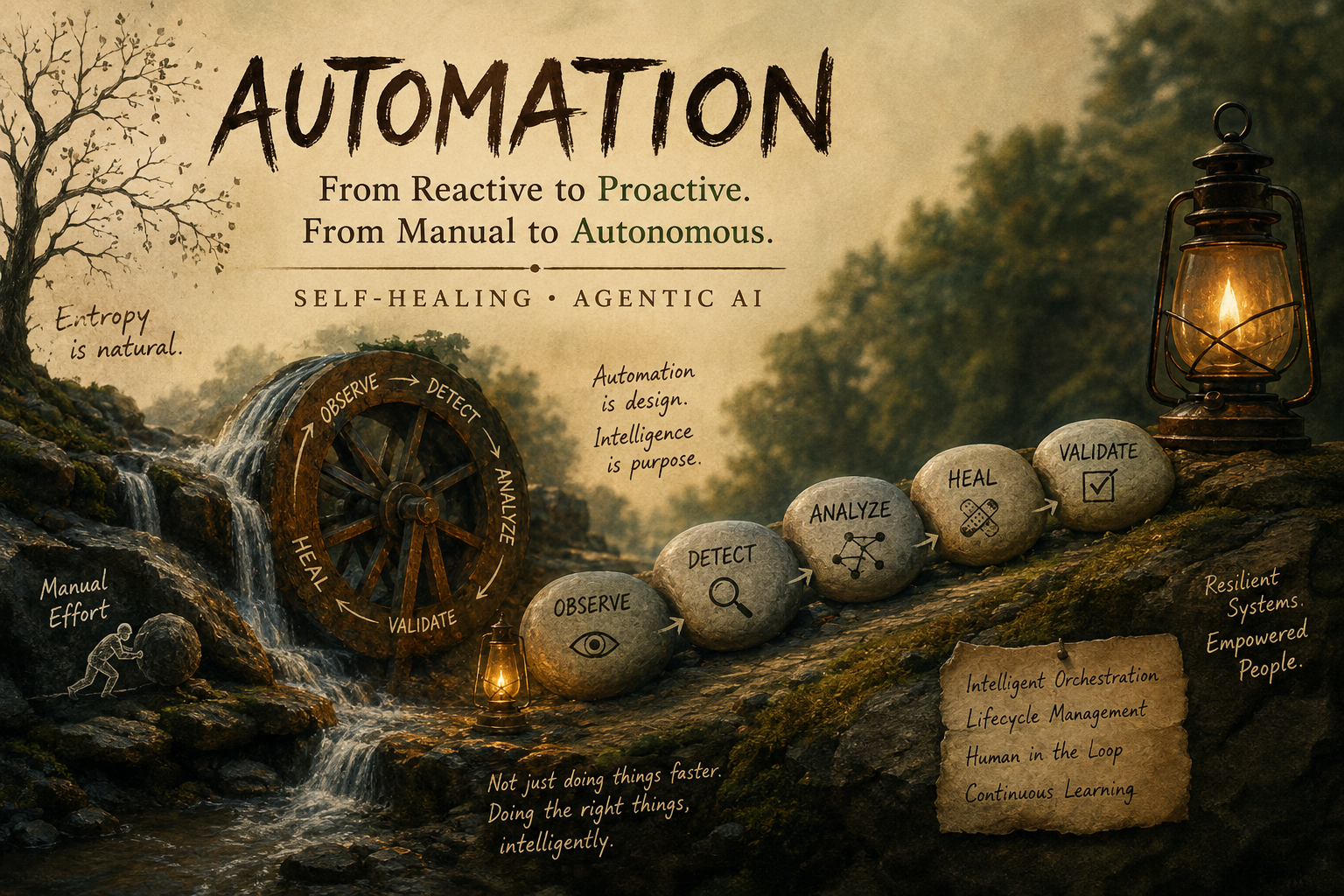
Let’s take a deeper dive, traditional self healing started with monitoring, detection, analysis, healing, validation cycle backs to monitoring.
Monitoring is the key. It acts as the control for the entropy of a modern business. Monitoring is the tool we can use to directly observe, measure and control the randomness of a system driving modern business.
Identifying and monitoring the business pipeline is critical today. As organizations shift from monolithic architectures with centralized control points toward distributed microservices, visibility becomes paramount. In this context, ‘endpoints’ refers to the diverse nodes through which users and systems interface with the business.
The human body functions much like a microservices architecture, complete with built-in self-healing. While some might argue the human system is simply a distributed network, I view it as a collection of microservices: individual organs serve specific, localized needs while contributing to the overall purpose of the larger system.
Consider TSH as a prime example: it serves as a monitoring parameter for thyroid function, acting much like an API that communicates critical status updates to the pituitary gland.
In our daily lives we have thermostats, gas leak detection devices, smoke detectors to help us monitor and build a pipeline for automated actions.
In the enterprise world, monitoring now extends beyond infrastructure to include business pipelines and endpoints by constantly identifying detection points that feed into a centralized dashboard.
By analyzing this data, we can uncover opportunities for self-healing. While some scenarios can be resolved with a simple command, more complex issues require scripts that execute a sequence of actions. Modern systems offer APIs and simplified solutions to facilitate and validate these corrective actions. Even where APIs are absent, complex scripts can bridge the gap; increasingly, product engineering is focusing on addressing these pain points to simplify the path toward effective self-healing.”
While scripting bridges the gap, we must acknowledge the limitations of current approaches. Relying on hardcoded logic to capture alerts and execute pre-defined scripts often creates brittle systems that struggle to adapt to the dynamic reality of enterprise environments. This rigidity highlights a clear gap: we have the data, but we lack the flexibility to evolve. Have we finally found the tools required to bridge that gap? The answer lies in the next evolution.
Agentic AI
Agentic AI and Gen AI represent the next leap in this evolution. But should you self-heal with Agentic AI? As organizations build AI frameworks tailored to their unique business goals, the focus must shift from simple automation to intelligent orchestration of systems.
A robust Agentic AI framework typically includes, but is not limited to, Human-in-the-Loop protocols, continuous monitoring and improvement, auditing, accountability, impact analysis, AI review boards, lifecycle management, and privacy & ethics policies.
By establishing these guardrails, we ensure that Agentic AI isn’t just another layer of automation, but a true force multiplier. It transforms self-healing from a rigid script into a dynamic, intelligent process, thus returning the focus to where it truly belongs: empowering humans to focus on innovation rather than maintenance.