
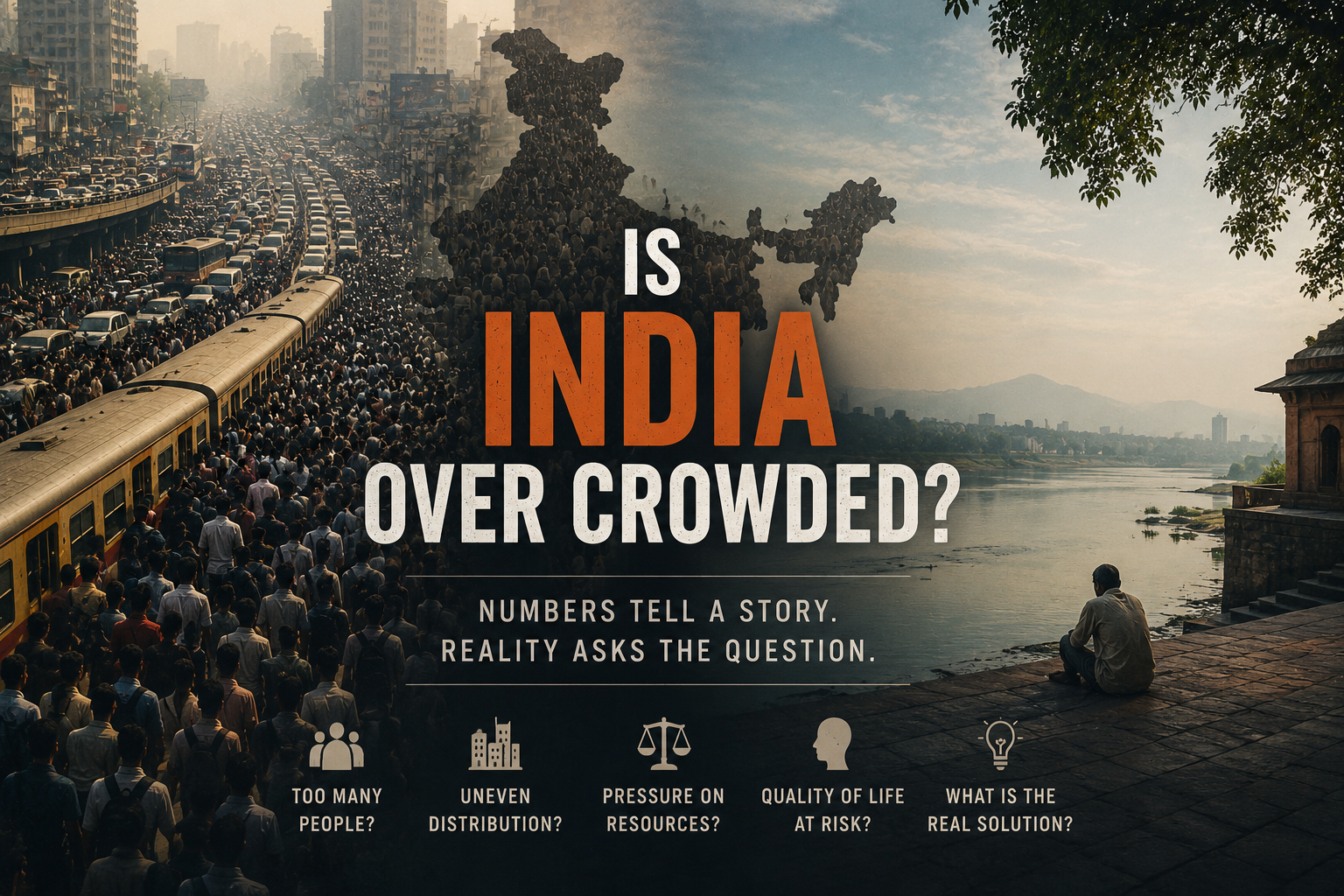
A question that echoes in my mind each time I step outside. But the answer depends on the door you walk out of. In the heart of a city, it feels like a definite yes. Elsewhere in the rurals, not so much.
So why are cities overcrowded? Or am I being harsh in terming overcrowding?
Lets Explore!
The reasons are familiar: job opportunities, better infrastructure (or at least that used to be the case), access to education. Cities offer a stage for life’s many pursuits. Cities are often the gears that drive the Nations economy and depict the Nations growth. We marvel at the architecture, the café & the shop interiors, and the gigantic malls.
Cities are magnets, and magnets attract.
With time, the education, job oppurtunities increased steadily and now we are at a explosive phase. But the word, “crowd” is subjective. Tolerance varies, often proportional to the cause. Who am I to call a city overcrowded when every resident is fighting to live, to survive, to thrive? People wear many hats, lead layered lives and lifestyles varies. Is the infrastructure also layered or fractured?
Infrastructure must serve all and without bias.
It begins with the road. Like any resource, it’s finite. When we talk about “Roads” we often connect ourselves to the black strip, to most of us the words pedestrian platforms, drainage, pipelines are not associated until the stage is broken.
Roads, pipes, drains, they all have a breaking point. You can tweak them temporarily, but the load doesn’t vanish. The load scales with time, have these scaled or improved with time?
So, who monitors these resources? Who is responsible for decision on scaling?
We pride ourselves on IoT and AI, the buzzwords for over a decade.
Have they failed us?
Were they ever truly implemented?
To most the answer is simple: there is no solution. Population!
Surprising? Maybe. But sometimes, honesty is clarity.
Let’s take a thought experiment: calculate the total length of all vehicles registered in a city over the past 15 years. Compare that with the length of the street. Now imagine parking two-wheeler on both sides of the road. Would there be any road left?
Traffic flow is directly affected by vehicle volume. Illegal parking narrows roads.
A single road connects multiple high-rise apartments, no separate entry/exit lanes. Public transport helps but only to a small extent. And last-mile connectivity?
How far are we willing to walk or cycle? Are those options even safe?
Pedestrian neglect is equally high. We blame motorists, but ignorance of rules is shared and should be shared. If signal duration aren’t respected, how do we expect to control chaos?
Overcrowding isn’t just about people around me!
If I have an emergency, can I reach a hospital in time? Will a bed be available? A doctor? When I walk to the neighborhood store, is the pavement clear or blocked by parked vehicles and electric posts?
78 years post-independence, it’s time to detach ourselves from city mania. Let old cities stand as cultural testaments. Let new cities rise as models of planning and dignity.
This is a manmade disaster. The blame doesn’t lie with census figures alone. Other metrics screamed the warning: housing loans, vehicle registrations, school enrollments, employment data… All information was available and all indicators flagged red. But no one to notice.
I wish our rights were valued. Let’s hit reset. Let’s build a more efficient nation by our 100th year of independence.