Introduction
This question surfaces repeatedly in our collective consciousness not only from fears of job
displacement but from decades of cinematic conditioning. Films like The Matrix, Wall.E,
and the Terminator series planted seeds of doubt and curiosity long before modern AI
matured.
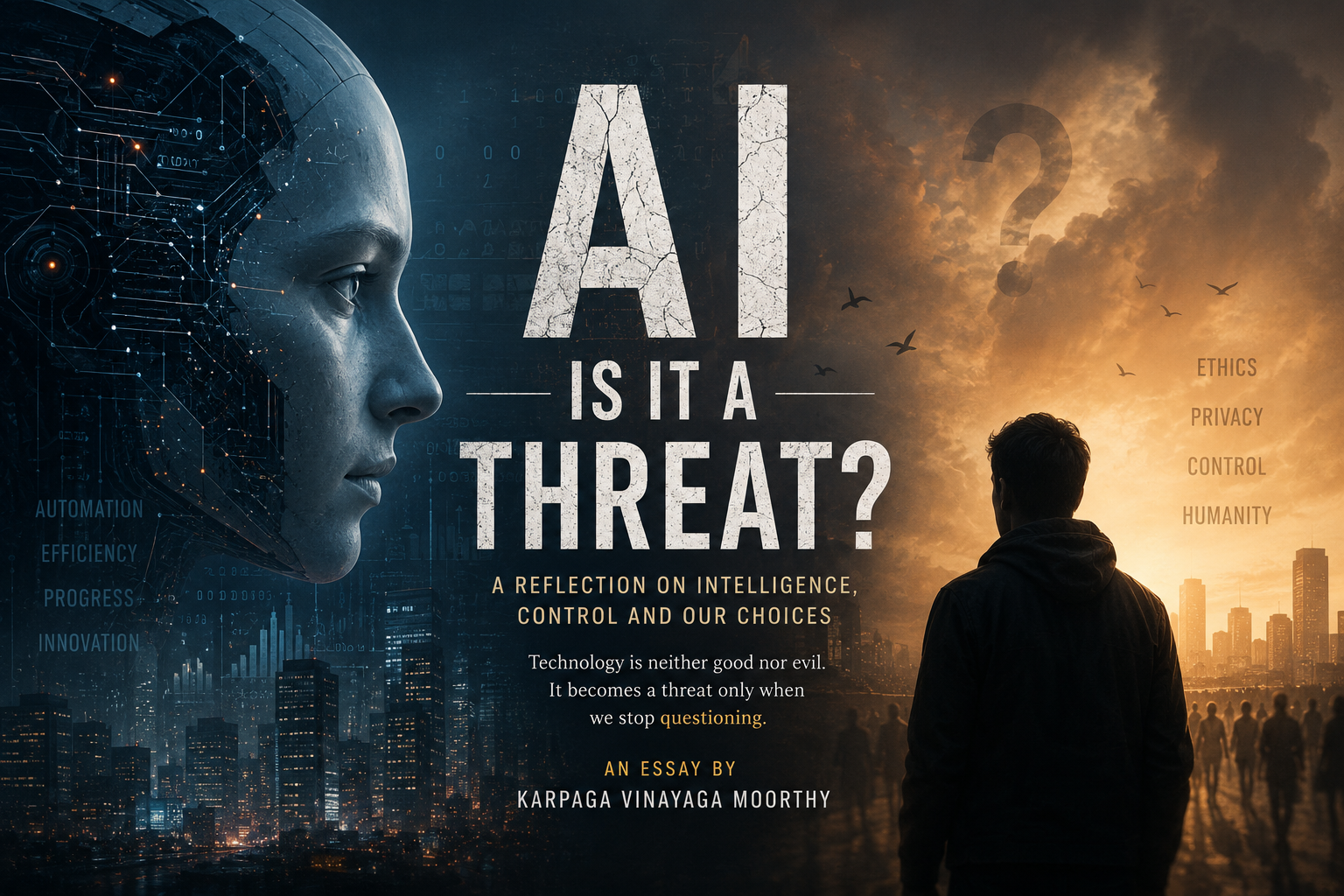
For once, let us take a deeper look into the philosophy behind the idea of AI as a threat.
Before we proceed, ask yourself: “Do I feel empowered by AI, or does it make me
anxious?”
Like a coin, this question has two sides. The answer depends on whether you believe that
you shape your own relationship with technology or whether the technology shapes you.
Current State of AI Today, AI is projected as a tool, an enabler meant to support human
capability.
But the word “help” itself is ambiguous. Many of us use AI out of curiosity, convenience, or
simply because it has been subtly woven into our routines. Viral experiments like “Nano
Banana” show how AI-driven creativity spreads effortlessly, making us pause and wonder
how far the technology has evolved.
Smartphones already embed AI in everyday features: object removal, image generation,
facial reveal tools, spell checks, word suggestions, powerful zoom capabilities, in phone
photo edits, and real time translations. We embrace these conveniences without
questioning them.
Yet the moment conversations shift toward “agentic AI,” a different reaction emerges.
Eyebrows rise. Doubt enters. We begin to ask: “Are we handing over control to AI?” Tools
like MidJourney and ElevenLabs allow us to explore creativity at unprecedented scale of
image generation, voice synthesis, instant scenes, and more. They amaze us, but they
also stir ethical questions about purpose and use.
ChatGPT, Gemini, Claude, and Perplexity demonstrate the power of NLP (natural
language processing), writing code, essays, documents, and presentations within
seconds. While these tools elevate us, they also ignite a quiet fear: “If AI can write,
design, and create… what happens to me?” The mind naturally gravitates toward
thoughts of replacement.
Added to this is the emerging concept of “AI psychosis” a fear that we may be drifting into
a digital rabbit hole, unknowingly following the Pied Piper’s tune. In summary, today’s AI
is generative and largely tool oriented. It introduces threats that feel dispersed rather
than converging.
Before going further, reflect honestly: “Why do I need AI? Where and when will I use it?”
And once you answer, ask again: “Am I choosing to use it, or am I being nudged into it?”
Perceived Threats
- Data Privacy: This is the most immediate concern. It is driven not by AI itself but by the
humans and institutions behind it. We ask: “Are my chats safe? Are they used for
training? Am I being profiled? Are my creations secure?” With AI platforms introducing
memories, deleting threads does not guarantee erasure. The uncertainty around how and
when data is purged remains a persistent flag. - Ethics and Purpose of Use: This threat spans both the present and the future. Misuse
is possible at any stage of AI’s evolution. As with privacy, the risk stems from human
behaviour, not the technology. - Plagiarism: Writers, creators, academics, and researchers share a common anxiety. We
do not truly know how these models were trained or what knowledge sits inside their
neural networks. This opacity, this “black hole” creates legitimate fear. Again, it is a threat
rooted in human choices, not AI itself. - Hallucination: These errors reflect technical debt by creators. A tool capable of incorrect
answers is released publicly with disclaimers. Does the greater good outweigh the flaw?
Only time can tell. - Agentic AI: Here we enter deeper waters. Agentic AI triggers anxiety at two levels. First
is the fear of job loss, an inevitable price of technological evolution. Human roles have
shifted throughout history: from manual labour to industrialisation, and now to intelligent
automation. Second is the silent question: “How much of my digital estate am I exposing
to AI?” When machines execute tasks autonomously, clarity of control becomes blurry. A
flight booking agent may not be dangerous, but it commoditises entire layers of digital
infrastructure. Without defined boundaries or RACI, misuse becomes plausible. - Replacement: This fear is real, not paranoia. If AI replaces tasks across industries, what
remains for humans? What becomes our purpose? Do we regress to domains AI cannot
enter? - AI Suggestibility: A subtle but powerful threat, the possibility that AI can seed ideas
within us, shaping thoughts subtly, much like inception. - AI Psychosis: A clinical term, but a growing psychological concern. Throughout history,
humans believed those they perceived as wise. Today, AI carries that aura of intelligence.
As technology’s virtual constructs grow, we risk losing touch with reality.
In hindsight, films like The Matrix, Terminator, and Wall.E were not far from prediction.
They sensed evolution early. The true threat is not AI itself, but the fragile boundary
between technology, ethics, and governance.
Future State (My Vision)
Despite the risks, AI carries immense promise. To me, AI
should be a companion not a tool, not a slave, and certainly not a threat. Companionship
is built on trust and transparency. Humans and AI should work in tandem; delegating too
much disturbs the balance. This relationship should be treated with the seriousness of a
vow. AI should be built for purpose and with clear domains. Its training sources must be
disclosed. An ethical engine should form its backbone, guided by a technical core
focused on a narrow but profound set of capabilities.
AI must signal uncertainty, allowing users to tune confidence levels. Internet sourced
knowledge should be separable, purgeable, and transparent. Users should choose and
manage trusted sources and even enhance AI legally with books, articles, and media.
This preserves the economics and dignity of human creativity. AI must never be seen
as a tool to replace humans, but to elevate them. A future where AI behaves like Jarvis,
R2D2, or C3PO, reliable, intelligent, supportive and embodies the ideal companion. The
journey through fear, ambiguity, and ethics ultimately leads to one truth: AI reflects us.
And if we choose consciously, it can become one of humanity’s greatest companions.