The moment I started to write stories and novels, I always wondered what would be my style. The text almost felt like DNA, something coded beneath the words, quietly shaping how a reader takes it in. I started to write to give my thoughts the shape they required and to offload the ideas and themes that pop into my head non-stop.
The Scene: A confrontation between a husband and a wife, witnessed by their mutual well- wisher.
Wow. Writing is simple, I have just narrated what I want in a sentence.
Style 1:
Esther snapped, “Why would you say this?”
Christopher, annoyed, stood silent.
Sam hit back, “You made me say it; I have had enough.”
Tears rolled down Esther’s cheeks, her hands resting on her bump and with deep breaths, lowered herself on a chair.
Sam walked towards the wall in frustration.
Bang! Bang! He launched his fists into the wall.
Style 2:
Esther’s eyes were moist, a tear rolled down her cheek, her trembling hands weren’t quick enough to catch it. She closed her eyes, cleared her throat, words choked her.
She could hear her own heartbeat getting louder than her voice. She clasped her fingers tight, “Sam, why would you say this?”
As the words echoed, she lowered herself on a chair and sat with her face buried in her arms, shielding her baby bump.
Christopher stood in silence, his eyes flickering between Sam and Esther — he didn’t know who needed him more.
Sam stepped closer to Esther, hesitated, then swiveled and punched the wall with frustration. “You made me say these words, Esther!”
“I’m sorry, but I have to clear the air, for our future.” He turned away from Esther and Christopher.
Let’s approach this scene with different parameters, the ones that might matter to convey the thought and the after-effect it might have.
The thought is of the writer and that has to be conveyed and the after-effect is on the reader after reading the text. To analyze the after-effect of the reader, let’s take two parameters: speed and point of view.
Speed:
When we talk about speed, it is the ability of the text to be read easily and consumed by the reader.
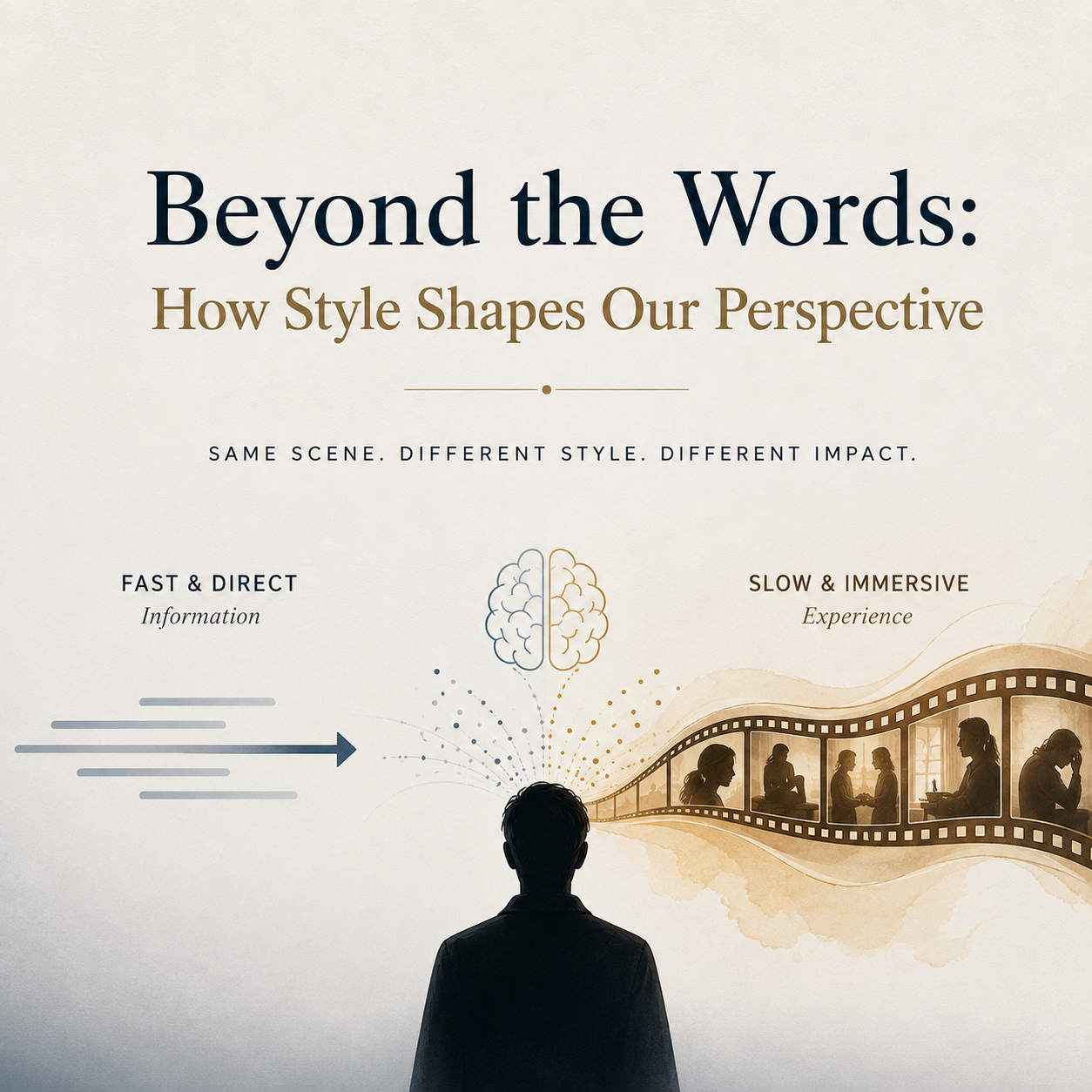
Style 1 – Uses short sentences and dialogue tags to convey the emotions. The scene is over before the reader settles into it.
Style 2 – The speed is deliberately slowed to make the reader live through the emotions. The focus is not more about the argument, but the emotions. There is a pause to convey the characters’ emotions.
Point of View:
Point of view is the lens through which the reader experiences the story. The tricky part, when the story unfolds through a character and speaks through the character, the point of view is what the character sees. Easier to control and helps avoid the exposure trap.
Style 1 – Uses the third-person narrative, all three characters are in the scene, the reader is outside the frame observing.
Style 2 – Uses the third-person narrative too but the point of view shifts from person to person, as per the scene unfolding. The reader is submerged into the frame, the reader lives in the scene.
Let’s explore the styles in terms of filmmaking.
Style 1 – Can be made as a single shot. From a wide angle, showing the three characters in the frame and the argument unfolding and cut with the bang. It feels cinematic, helps convey the scene with less footage.
Style 2 – The scene is switched with small shots to tell the story. It starts with the camera moving closer to Esther, showing the tear roll off her cheek, her trying to catch the falling drop, trying to speak, but her words choke.
Pause and use the pause to establish her heartbeat getting louder.
The next shot, the camera slowly zooms out, Esther stands still with her eyes closed and hands clasped tightly. The moment she utters the words, the camera shifts between a close-up of Sam, Christopher and a wide shot of the three, probably standing as three vertices of an imaginary triangle.
Both scenes convey the thought, but the way it is portrayed for the reader is different. There is no correct way to write a story. Tone and style always are closer to our personality. We can adopt styles based on the story demand and not cloud our style.
Let’s dive deeper, with this narrative style, let me draw a connection to our work style. The text we write and the words we speak have a DNA.
Let’s start with the scene statement which is short, precise and narrow. While the context is translated to the brain, the indexing doesn’t happen. It often is short-lived and might limit neuroplasticity. While the context is translated, it has a potential to evoke questions in the reader’s mind, as they look for anchors to serve as an index.
Use this with caution when you want your words to be registered and remembered by the listener.
Style 1 – is fast. It gets the attention of the listener. They might think they have received the message, but the indexing can’t keep up the pace with the information. ‘Esther snapped’, and ‘Sam hit back’ are dialogue tags to convey the emotion, when a page has many such tags, the cognitive load on the reader is high. The emotions are not lingered upon and even a well written scene might not sink in.
Style 2 – is slow, I won’t vouch that this is the best. But this method increases the chance of the message getting registered in the brain, anchored by sensory detail — in this scene, by emotion. The drawback of this style is that it is slow. The mind might want to skip, like the way our thumbs roll through content.
The cognitive layer hidden beneath the text often perplexed me. Be it academic reading or recreational reading, there needs a mechanism in the text to help establish anchors and allow the reader to connect the dots.
Ultimately, whether we are drafting a complex novel or a concise professional email, style is not merely an artistic flourish—it is a cognitive strategy. By recognizing writing as a spectrum between fast and slow, we gain the power to consciously shape the reader’s experience. It allows us to move beyond simply conveying information, enabling us to act as architects of memory, creating the necessary anchors that ensure our words resonate, linger, and endure.